Showing posts with label book business. Show all posts

Wednesday, April 10, 2019

What is in a marketing prospectus?


So, you've completed a manuscript... congratulations! And now you want to start sending it to publishers. (Or, shopping it to agents.) Many shops -- Pen & Anvil is one of them -- are prepared to consider a book proposal only if it comes attached to a marketing prospectus. What goes into such a thing?

Well, details and requirements vary. You can find detailed accounts of what is most useful to include in such a document in any guide to submissions, or by consulting an experienced editor or agent; but in our view at Pen & Anvil we believe a prospectus should definitely include:
  • an account of what books in market are comparable to yours (and how you made that determination), along with their sales prominence/numbers
  • an account of how you'd intend to participate in the sales marketing process -- festivals? course adoptions? reading groups? store appearances? leveraging your social media network? -- in the 1-2 years following your book's publication
  • an account of your promotional resources as an author (the size and Klout of your social media audience is relevant, but the more relevant question is: can you explain how you've had success using that social media network to drive a sales campaign, or something analogous like a petition, event registration, etc?)
  • a list of your primary "connections" in the literary sales space -- editors, program heads, etc; and so on. 
The whole document might come in at 2-4 pages. Your prospectus should be geared toward answering three questions in the affirmative:
  1. Has this author given serious thought to the work involved in promoting a book?
  2. Does this author have a realistic understanding of how their book compares to books in the market?
  3. Do resources existent to convert promotional labor into sales results for this book?
This might seem like a big ask, even an impediment. "I just wrote a BOOK! Why do I have to do all this additional work?" Actually, though, don't be discouraged by the requirement to prepare a prospectus. You should want only to work with a publisher who is considering the book through the lens of market prospects. If you aren't being asked questions up front, why should you trust that the publisher is oriented and equipped to connect an audience to your project?

You don't have to be a marketing expert to prepare a prospectus -- no publisher is going to expect you to lay out your philosophical preference for the funnel model versus the flywheel, for example. But you do need to be willing to work collaboratively with your publisher on the marketing and promotion of your book if you want to maximize your audience size. Each side is bringing something to the table: your publisher has the business systems, production acumen, and market intelligence; you have the authorial skill, the intellectual property, and the personal incentive. Together, you should work out a plan to work as an integrated marketing team so that your book can be discovered, sold, read, and enjoyed by the reader you want to connect with.

Tuesday, October 23, 2018

If Abebooks shuts you down, where will you go?

The following message was posted to the message board of the International League of Antiquarian Booksellers, and is reproduced here with the author's permission. - ZB

To whom it may concern:

Antikvariat Valentinska is a large antiquarian bookstore based in the centre of Prague, Czech Republic. We have been selling books through ZVAB for about 15 years now. In 2014, we joined AbeBooks; in 2015, ZVAB definitely ceased to exist as a distinct website for booksellers.

Meanwhile, Abebooks has become the largest and almost singular marketplace for selling antiquarian books on a worldwide basis. The simple truth is that whether someone likes it or not, there is no reasonable alternative to AbeBooks at the moment.

In all those years, we have done our best to satisfy our customers and to maintain the best seller rating. We have never encountered a major complaint, neither by our customers nor by the administrators of AbeBooks. Whatever money we have taken in, we have regularly shared the agreed upon portion of our profit with the owners. Currently, we offer more than 20,000 individual titles on AbeBooks, from the Late Middle Ages to brand-new books.

On Thursday, 18 October, we received the following email from the seller support of AbeBooks:
Effective November 30, 2018, AbeBooks will no longer support sellers located in certain countries. Your business is located in one of the affected countries and your AbeBooks seller account will be closed on November 30, 2018. We apologize for this inconvenience.
The decision to close our account on such short notice has come as a complete shock, especially since no reason was not given even upon request. Just our company alone will almost certainly have to dismiss at least five employees. Furthermore, we do not have any idea where else to sell about 20,000 foreign books.

We are deeply concerned about this step, not only because of our own financial losses to come.

In light of the monopoly position of AbeBooks, closing all seller accounts in the Czech Republic, Poland and Hungary (as far as we know, these are the countries concerned) will basically mean nothing short of cutting these countries off from the worldwide trade with antiquarian books. Which countries will be next?

Whatever the reasons may be, the fair worldwide trade with antiquarian books will not profit from this step.

We therefore kindly ask the AbeBooks and Amazon administration to reconsider this unfortunate and discriminatory step.

Jan and Ondrej Schick
www.valentinska.cz
Antikvariát Valentinská
Valentinská 8
110 00 Praha 1 - Staré Město
Czech Republic

Monday, May 14, 2018

An editor's reply to #MeToo in bookstores

What a relief to read that bookstores have at last assumed their proper role as censors and arbiters of public morals. Banishing Diaz, Alexie, and Wallace is, I assume, only the beginning. I mean, we all know about the Beats—Kerouac (misogynist), Ginsberg (Man-Boy-Love Association member), Burroughs (murderer). But what about Mailer, Bellow, Salinger, Updike, Hemingway, and that notoriously bad father, William Faulkner? Don’t forget antisemites like Pound and Eliot. And you know that Robert Lowell could be savage to people? If you stock Plath and Sexton, aren’t you glamorizing suicide? People say Mary McCarthy had quite a tongue on her. And what about cranks like John Milton—anti-Catholic, anti-Irish, pro-regicide….And please don’t get me started on Byron (incest), Shelley (cheating), Baudelaire (whoring), Rimbaud (gun-running). But these literary cats are the low-hanging fruit. Imagine the moral probity of those bookstores deciding not to stock the shelves with work by and about bona-fide mass murderers—not only the obvious ones, like Hitler and Stalin, but also our own men and women: Nixon, Kissinger, Johnson, the Bushes, the Clintons, Madeleine Albright, Janet Reno (Waco—never forget!)? Then there are lesser criminals like Martha Stewart, who will also need to be purged. But we’re just getting started, aren’t we? From here on, as in any self-respecting theocracy, shelf-space should be reserved exclusively for the works of bona fide saints. Here is where it gets tricky, though, because surely the Bible will have to go—what other book has led to as much bloodshed, from the Crusades to the present? Keep in mind how Jesus provoked a crowd to stone the adulteress: “He that is without sin among you, let him cast the first stone.”
(Source)

Food for thought. Another Biblical precept: "Ye shall know them by their fruits."

Friday, February 23, 2018

All in the name of book-buying

In which our man in Nigeria reflects on the hustle of the local book-seller.
The man who sells second-hand books close to the University's gate, from whom I get most of my novels from, is in the habit of wanting to recommend books for me. 
Apparently, he has read a whole lot of them and feels he is in a better position to decide the best for me. I am often amused at this. I agree that I am quite terrible at making the right choices for commodities I need, but definitely not when it comes to books. I like to browse through and have a good look at them before I decide, and I like to make the decisions myself. 
The few times I decided to humor him so as not to hurt his feelings, and go with his recommendation, I ended up not enjoying the reads. The man is a fan of sci-fi. I hardly understand sci-fi (unless it has a touch of reality, as in Lesley's or Innocent's) and I have tried without success to make the man understand that I would rather select the books on my own. He doesn't even seem to notice I usually don't go with his recommendations, Oga would still jump up to select books for me the next time I drop by wanting to buy. And I observed that he sells far cheaper to me than to others. 
A few days ago, he asked me why I hadn't been coming to check out the books this semester. I thought of how he successfully led me to starve in Year 1 all in the name of book-buying, until I took on the form of a dehydrated okporoko.
In this season, who has that kind of money to spare? 
Chukwuebuka Ibeh is a stringer for New England Review of Books, studying in Port Harcourt, Nigeria. 

Monday, October 31, 2016

Six translation recommendations from the Grolier

Grolier Poetry Book Shop, coming up on its 90th anniversary, is the oldest all-poetry bookshop in America.

The shop has been a home to many great poets, and poetry lovers from all over the world, and remains a destination for poets visiting Boston; one can always be sure to find conversation in its small square space tucked into a side street around the cover from Harvard Yard. Great poets who frequented the shop as readers and patrons include Elizabeth Bishop, Robert Creeley, ee cummings, TS Eliot, Allen Ginsberg, Frank O'Hara, Marianne Moore, Adrienne Rich, Frank Bidart, David Ferry, Michael McClure, Kimiko Hahn, Maxine Kumin, Robert Pinsky, Ariana Riens, and Franz Wright.

The latest selection of staff-recommended titles in translation appear below. Beyond the intrinsic value of the literature on offer, keep in mind that purchases made directly to a bricks-and-mortar shop not only help to show support for literary culture, but provide direct support to an institution that has hosted innumerable in-person encounters among writers, readers, and literature-lovers over the years.

Click here to learn more about supporting this irreplaceanble institution via direct giving to the Grolier Legacy Fund. Or, sign up here to receive their email updates directly.
Buy this title
Buy this title

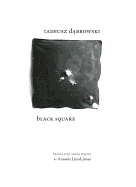
Black Square by Tadeusz Dabrowski

Translated from Polish by Antonia Lloyd-Jones. $15. Tadeusz Dabrowski was born in northern Poland in 1979. From his first volume, published in 1999, he has been critically acclaimed for poetry that combines a tone of metaphysical meditation with the theme of love. His poems are like snapshots taken by a sensitive camera that captures moments filled with the "caring absence" of God and intimacy with the woman the poet loves. Here we find gravity laced with humor and sublimity mixed with pleasure. So far Dabrowski has published five volumes of poetry in his native Poland, which have won him numerous awards. His work has appeared in translation in thirteen European languages. English translations of his poems by Antonia Lloyd-Jones have been published in leading literary journals including Agni, American Poetry Review, and Tin House. Black Square is his first collection to be published in English.

Antonia Lloyd-Jones is a translator of Polish literature. In 2008 she won the Found in Translation Award for her translation of The Last Supper, a novel by Pawel Huelle. Her other translations of fiction include works by Jaroslaw Iwaszkiewicz and Olga Tokarczuk. Her translations of poetry by Jacek Dehnel appeared in a recent anthology, Six Polish Poets, published by Arc Publications.
Buy this title
Buy this title

Black Stars by Ngo Tu Lap

Translated from Vietnamese by Martha Collins. $16. "A beautifully rendered translation by Vietnamese poet Ngo Tu Lap and acclaimed American poet Martha Collins, Black Stars introduces a man who is both attached to his war-haunted childhood home and deeply conversant with contemporary global life.

Simultaneously occupying past, present, and future, Black Stars escapes the confines of time and space, suffusing image with memory, abstraction with meaning, and darkness with abundant light. In these masterful translations -- printed alongside the original Vietnamese -- the poems sing out with the kind of wisdom that comes to those who have lived through war, traveled far, and seen a great deal. While the past may evoke village life and the present a postmodern urban world, the poems often exhibit a dual consciousness that allows the poet to reside in both at once. From the universe to the self, we see Lap's landscapes grow wider before they focus: black stars receding to dark stairways, infinity giving way to now. Lap's universe is boundless, yes, but also
just big enough
to have four directions
with just enough wind, rain, and trouble to last
Buy this title
Buy this title

Fusion Kitsch by Hsia Yu

Translated from Chinese by Steve Bradbury. $13. Steve Bradbury writes: "Hsia Yü's frank and innovative treatment of gender and sexuality in a small handful of poems in this collection and in her second collection Ventriloquy (Fuyushu) was seized upon by critics and scholars anxious to find a candidate to fill the long-vacant post of "Chinese feminist poet." But while Hsia Yü may well have been one of the first woman poets writing in Chinese to have written about love and romance in a manner that broke dramatically from the conventions and constraints of traditional Chinese women's poetry, if we bother to look beyond labels at the poetry itself, we will find a body of work that is far less interested in providing a critique of gender relations or advancing a sexual/textual agenda than in exploring the sensuous and quirky interface between the pleasures of the flesh and the pleasures of the text. It is this preoccupation with pleasure that sets Hsia Yü apart from other poets writing in Chinese today; that and the fact that her poetry embodies a fusion of styles and influences -- both high and kitsch -- with the French influence running perhaps stronger than most."

Among her numerous honors, Hsia Yü was most recently awarded the Taipei City Literature Award for her book Salsa.
Buy this title
Buy this title

Door Languages by Zafer Senocak

Translated from German by Elizabeth Oehklers Wright. $16.95. Lee Upton, author of Undid in the Land of Undone, writes: "Door Languages, in Elizabeth Oehlkers Wright's brilliant translation, sends us news of the stranger within us who keeps putting on and taking off a cloak of invisibility. This is bracing work. Line by insinuating line, Zafer Senocak peels back our most rigid assumptions. These poems, marked by the highest ambition, read like folk tales from the future." 

Askold Melnyczuk, founder of Agni: "A fine edgy satisfyingly demystifying voice."
Buy this title
Buy this title

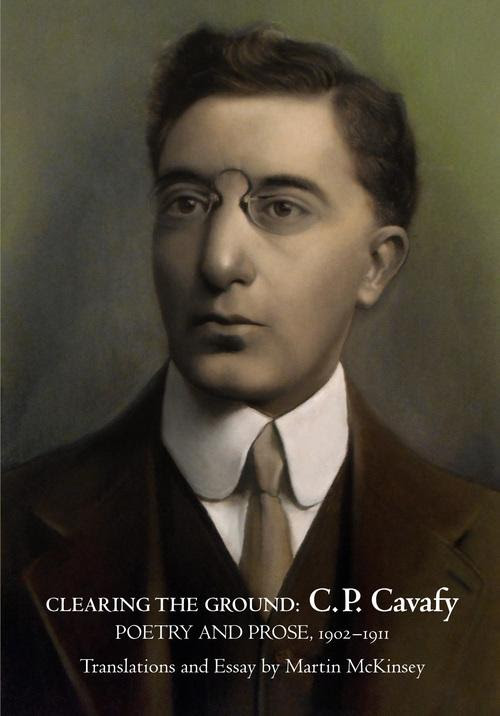
Clearing The Ground by C.P. Cavafy

Translated from Greek by Martin McKinsey. $17. "Clearing the Ground conveys the texture of Cavafy's written life through the course of a near decade -- the threads of preoccupation, the unfolding elucidations, the occurrence of the poems in their shining clarity. What appears is an active and intimate image of Cavafy, the poet and the man."
I know that I am cowardly, and am unable to act. Therefore I confine myself to words. But I don't think that my words are without purpose. Someone else will act. But my many words -- the words of a coward -- will make it easier for that person to act. My words clear the ground.
~ Cavafy, 1902
Buy this title
Buy this title

Darkness Spoken by Ingeborg Bachmann

Translated from German by Peter Filkins. $24.95. Ingeborg Bachmann was born in 1926 in Klagenfurt, Austria. She studied philosophy at the universities of Innsbruck, Graz, and Vienna, where she wrote her dissertation on the philosophy of Martin Heidegger. In 1953 she received the poetry prize from Gruppe 47 for her first volume, Borrowed Time (Die gestundete Zeit), after which there followed her second collection, Invocation of the Great Bear (Anrufung des großen Bären), in 1956. Bachmann also went on to write short stories, essays, opera libretti, and novels, including The Thirtieth Year, Malina, and The Book of Franza. At the time of her death in a fire in Rome in 1973, Bachmann was at work on a cycle of novels titled Todesarten (Ways of Dying), of which Malina was the first published volume.

Along with her close friend Paul Celan, Bachmann was considered the premiere German language poet of her generation. Her various awards include the Georg Büchner Prize, the Berlin Critics Prize, the Bremen Award, and the Austrian State Prize for literature. Her work remains highly influential to this day, and she is now regarded as a pioneer of European feminism and postwar literature. Influencing numerous writers from Thomas Bernhard to Christa Wolf, Bachmann's poetic investigation into the nature and limits of language in the face of history remains unmatched in its ability to combine philosophical insight with haunting lyricism.

Peter Filkins has published two volumes of poetry, What She Knew (1998) and After Homer (2002), and has translated Bachmann's The Book of Franza and Requiem for Fanny Goldmann. He is the recipient of an Outstanding Translation Award from the American Literary Translators Association and the Berlin Prize from the American Academy in Berlin. He teaches at Simon's Rock College of Bard in Great Barrington, Massachusetts.

Tuesday, July 5, 2016

How small publishers matter

An observation on print runs and the need for small presses, made by Andre Schiffrin in his book The Business of Books, p.147:
Let's make this as explicit as possible: If books with small print runs disappear, the future will die. Kafka's first book was published with a printing of 800 copies. Brecht's first work merited 600. What would happen if someone had decided that was not worth it?

(As spotted by Stephen Sparks -- a "Reader; book buyer &c. @greenapplebooks / @gabsunset; infrequent writer; & constant worrier. Co-editor at @WritersNoOneRds and steering committee @BayBookFes" -- and shared on Twitter this past April.)